Guide
The Bánffy Palace: what the building is, and how to get inside
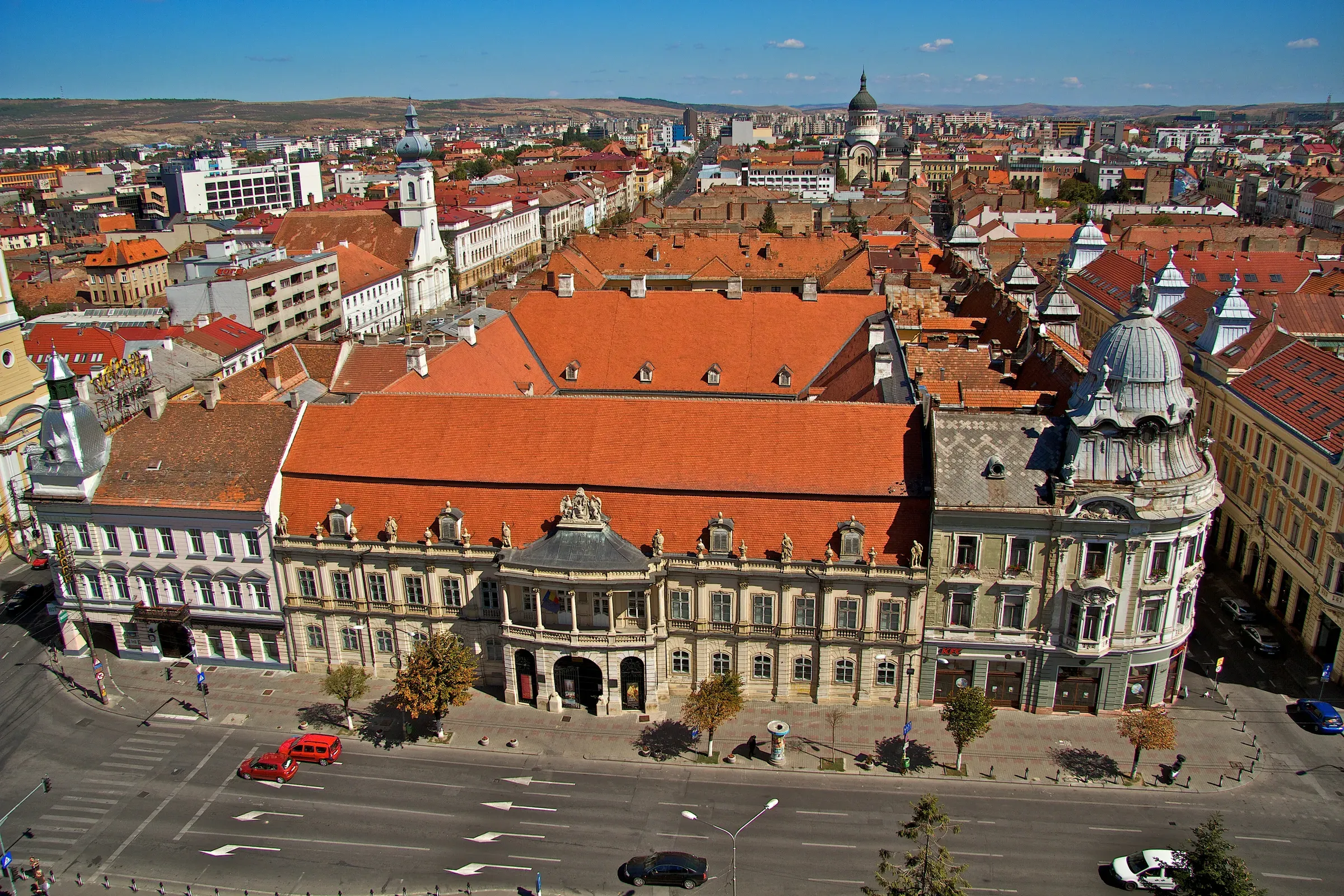
The most representative Baroque building in Transylvania stands on Piața Unirii and has housed the Art Museum since 1951. Its opening hours do not appear in the museum's Google listing. They are here.
A hundred and forty people a month search for “palatul banffy cluj”. What they find, in order: Wikipedia, the museum's site, a tourism blog, and — in fourth place — Bánffy Castle at Bonțida, which is a different building thirty kilometres away.
So, plainly, first: the palace is at Piața Unirii 30, in the centre of Cluj. The castle is in Bonțida. They are not the same thing.
The building
Built between 1774 and 1785 for Count György Bánffy to designs by the German architect Johann Eberhard Blaumann, around a rectangular courtyard. It cost 40,000 forints.
It is held to be the most representative Baroque building in Transylvania. The rococo frontispiece carries the Bánffy coat of arms and six statues: Hercules, Apollo, Mars, Minerva, Diana and Perseus, left to right. Worth looking up before you go in — they have been there for over two hundred years and almost nobody counts them.
The palace hosted the emperors Francis I and Franz Josef. It is a historic monument of national importance, listed in 1992, 2004 and 2010.
What is inside
Since 1951, the Cluj-Napoca Art Museum. The core of the collection is the Virgil Cioflec Collection, with works by Nicolae Grigorescu, Ștefan Luchian, Dimitrie Paciurea, Theodor Pallady, Camil Ressu and Vasile Popescu, spread across more than twenty rooms.
The permanent display also shows lesser-known Transylvanian artists of the eighteenth and nineteenth centuries, and a significant holding from the Baia Mare school of painting.
The floor holding the National Gallery was closed in 1990 for restoration and reopened in 1996. In 1997 the museum was nominated for EMYA, the European Museum of the Year award.
The hours, which are hard to find
Wednesday to Sunday, 10:00–17:00. Last entry to the exhibition spaces: 16:30.
Closed Monday and Tuesday. That is the detail most people miss: two days in seven, not one.
Phone: 0264 596 952 or 0753 066 791. Email: [email protected]. Tickets can also be bought online through the museum's site.
We took these from the museum's own page, on the date above. Correction, 10 September 2026: this originally said the hours do not appear in the Google listing. They do, and they are correct. The verified truth is a different one: the museum's listing is not claimed by the institution.
While you are there
At number 31, immediately next door, is the main building of the University of Art and Design. The city's art museum and its art school are neighbours on the same square.
And if you are going with children: a last entry of 16:30 means a morning visit around 10:30 leaves you the rest of the day. Piața Unirii is right outside when you come out.
What this is about
- Muzeul de Artă Cluj-Napoca →
The city's art museum, housed in the Bánffy Palace. A thousand searches a month — the second art destination in Cluj after the theatre.
- Universitatea de Artă și Design din Cluj-Napoca →
The city's artist factory. Almost the whole generation labelled the “Cluj School” trained here.