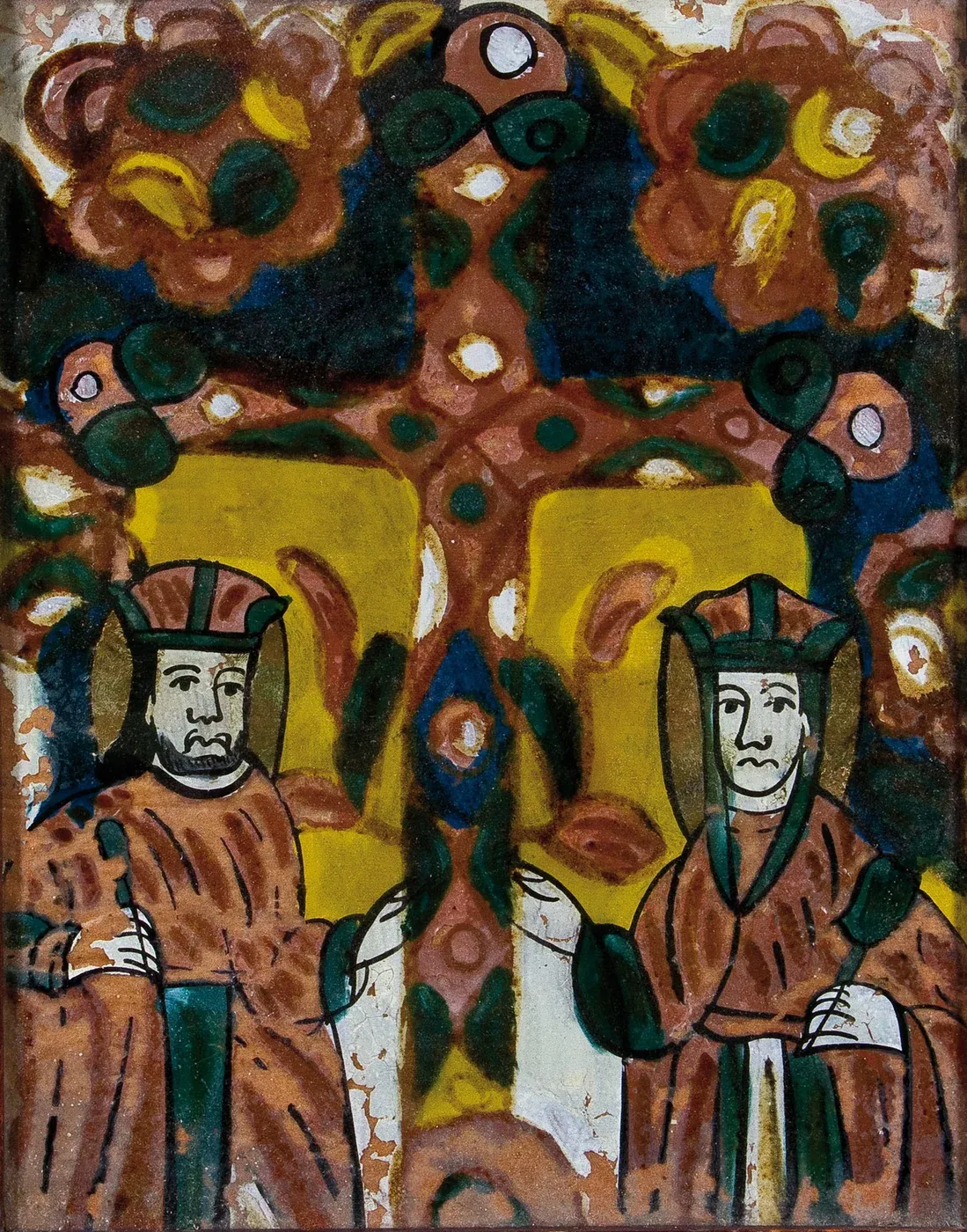
Painting on the back of the glass
A glass icon is painted on the back of a pane and seen through it. The glass does two jobs at once: it carries the painting and it replaces the varnish that a wooden icon gets at the end. The colours sit directly on the glass, which gives them their particular clarity and glow.
The technique reached Transylvania from Central Europe, along a route through Bavaria, Austria and Bohemia, in the 17th and 18th centuries. At Raimundsreut in Bavaria, about 40,000 pieces a year were made in the early 19th century. Nicolae Iorga dated the oldest Romanian glass icon he knew, the three angels visiting Abraham, to around 1670 to 1680, judging by the shape of its letters.
Some older texts also tie the craft to the Habans, the Anabaptists who settled near Alba. The sources we checked do not support that link. The Habans, first known as Hutterites, settled at Vințu de Jos in 1621 at the invitation of Prince Gabriel Bethlen, and most of them left in 1765. Their documented craft is pottery, white tin-glazed faience painted in four colours, not glass and not icons.
Nicula and the weeping icon
Nicula is a village near Gherla, about 50 kilometres from Cluj, in the commune of Fizeșu Gherlii. Its monastery keeps an icon of the Mother of God with the Child, painted on wood in 1681 by the priest Luca of Iclod. According to an Austrian official report, the icon wept between 15 February and 12 March 1699. The year 1694, which sometimes circulates, does not appear in the sources we opened.
In 1713 the governor Sigismund Kornis took the icon to his noble residence. It eventually came back to Nicula. News of the miracle drew pilgrims, and the pilgrims wanted to take the Virgin's image home. Some villagers began painting it on glass to sell. That is how Nicula became the first centre of glass painting in Transylvania as a mass phenomenon, with a production that lasted close to 250 years.
The pilgrimage continues. The monastery's biggest feasts are 15 August, the Dormition of the Mother of God, and 8 September, her Nativity. On the eve of 15 August hundreds of believers walk from Gherla to the monastery, and thousands come on the day itself.
How the painters worked
Icons were painted from izvoade, pencil or paint tracings on paper taken from older icons and sometimes from lithographs and woodcuts. An izvod was taken out now and then, placed under the glass and then put away again. The most skilled member of the workshop traced its outlines in black. This graphic skeleton, called the urzeală, was reproduced in series. Others filled in the colours following set rules, and the head of the workshop did the final retouching.
The order is the reverse of painting on wood. On the back of the glass the drawing and the inscriptions come first, then the highlights and shadows, and the background last. Nothing can be corrected afterwards, and the painter has to remember that the whole composition will read as a mirror image. Colours were ground from powders and bound with linseed varnish. In the work of Savu Moga, a painter from Țara Oltului studied by conservators, the binders are egg and linseed oil.
Gold leaf is rare and mostly used for the saints' haloes. Over time bronze powder replaced it, and many painters placed silvered paper behind the paint, which protected it and sometimes served as the background. Old glass came from small glassworks around Cluj and in the Apuseni Mountains, in thin sheets with ripples and air bubbles.
The Nicula style and Saints Constantine and Helen
Nicula drawing is naive but expressive, with simple, clear compositions, no anatomical proportions and no perspective, but balanced in colour. Figures are frontal and symmetrical. In the first period, up to the mid-19th century, icons were small, around 30 by 25 centimetres, with a border shaped like a twisted rope. Later they grew larger, with frames of red roses and brighter colours.
Painters did not sign or date their work, so most remain anonymous. A few names are known from the second half of the 19th century and the early 20th, among them Tudor Tocariu, Dionisie Iuga, Ștefan Mircea and Ștefan Belindean. The oldest known dated Nicula icon is from 1802 and belongs to the Ethnographic Museum of Transylvania in Cluj. Pedlars carried them in baskets as far as Bihor, Maramureș and Oaș.
The icon pictured on this page shows Saints Constantine and Helen, one of the regular Nicula subjects. It measures 28.5 by 23.5 centimetres and is dated to the first half of the 19th century, the period of the small icons. The painter is unknown. Its Wikimedia Commons record describes it as a reverse glass painting from Nicula, from a German auction, and marks it as public domain.
Other centres in Transylvania
For a long time Nicula was thought to be the only centre of glass painting in Transylvania. It was not. Nearby, in Gherla, painters worked in the same style. In the 18th century glass painting spread to the south of Transylvania as well, to Țara Bârsei, the Sebeș-Alba area, the region around Sibiu and Țara Făgărașului. Laz and Lancrăm, in Alba county, grew into centres from that time. The sacred art museum in Alba Iulia also attributes icons to Maierii Alba Iuliei and Șcheii Brașovului.
Some Nicula painters moved south, to Șcheii Brașovului, Arpașu de Sus, Făgăraș, Mărginimea Sibiului and Țara Oltului. The best-known case is Savu Moga, born in 1816 at Giurtelecu Hododului in Sălaj and settled around 1844 at Arpașu de Sus. He already knew the craft, probably learned at Nicula or Gherla.
At Sibiel, in Mărginimea Sibiului, the priest Zosim Oancea asked villagers to donate glass icons to the church. That collection became the Museum of Icons on Glass that bears his name, founded in 1969, with several hundred pieces from Nicula, Mărginimea Sibiului, the Brașov and Făgăraș areas and other regions. Radio Romania International speaks of more than 600 icons, the CIMEC museum guide of 700.
Decline and revival
The decline began in the early 20th century. When the Dancus, a husband-and-wife team of glass icon researchers, surveyed the village in 1972 they found almost no icons left. Only one painter was still at work, Gheorghe Feur, known as Clopotarul, together with his daughter Mariana. The monastery's wooden church, which held about 200 icons, burned the following year.
Interest from researchers, publishers and collectors brought the subject back in the late 20th century. At the monastery, the hierodeacon Ilarion Mureșan, who came to Nicula in 1962, painted glass icons and exhibited them. From 1995, Niculina Sanda Albu, a founding member of the Academy of Byzantine Arts and Studies in Cluj-Napoca, worked to recover the way icons were painted in the Nicula workshops, and in 2004 she taught glass icon painting to the monastery's monks.
Where to see them near Cluj
In the city, the Ethnographic Museum of Transylvania holds more than 550 glass icons from all of Romania's traditional schools, including the oldest dated icon from Nicula. Its exhibition in the Reduta Palace, at 21 Memorandumului Street, is open Wednesday to Sunday, 10:00 to 18:00. Not the whole collection is on permanent display, so it is worth asking the museum what is on view during your visit.
The Atelierul de icoane gallery, at 5 Piața Ștefan cel Mare, hosted an exhibition of glass icons in the Nicula style in 2025, organised with the Academy of Byzantine Arts and Studies. If you want to buy, a new icon is best bought directly from the painter. Old pieces turn up at auction houses, and for those the provenance papers matter. Nicula is about 50 kilometres from Cluj and fits in half a day, while Sibiel, near Sibiu, deserves a separate day.
Sources
- Definiția, filiera Bavaria-Austria-Boemia (sec. XVII-XVIII), Raimundsreut (~40.000 piese/an, oprit în 1875), Sandl în patrimoniul UNESCO din 2012, izvod și urzeală, muzeul Zosim Oancea. · ro.wikipedia.org
- Nicula la ~50 km de Cluj, producție de ~250 de ani, cele două perioade (30x25 cm cu torsadă, apoi 40x50 cm cu ruje), paleta de opt culori, materiale și pensule, foița de aur înlocuită de bronz, împărțirea muncii în familie, colportaj, 46 negustori în 1891, migrarea iconarilor spre sud, cercetarea Dancu din 1972, Gheorghe și Mariana Feur, incendiul bisericii, reînvierea de la sfârșitul sec. XX. · ro.wikipedia.org
- Icoana pictată în 1681 de Luca din Iclod, lăcrimarea între 15 februarie și 12 martie 1699, Kornis 1713, revenirea icoanei la Nicula, hramurile de 15 august și 8 septembrie. · ro.wikipedia.org
- Maria Flavia Pop (Muzeul Țării Crișurilor): datarea lui Iorga (~1670-1680), stilul Nicula fără proporții anatomice și perspectivă, izvoade și urzeală, minunea din 1699, cea mai veche icoană datată (1802) la Muzeul Etnografic al Transilvaniei, nume de iconari, Gherla, centrele din sud, glăjăriile, ordinea lucrului, foița de aur, ramele. Sursa formulării despre habani (preluată din dicționarul Stoica-Petrescu). · biharea.mtariicrisurilor.ro
- Habanii: anabaptiști hutteriți, stabiliți la Vințu de Jos în 1621 la invitația lui Gabriel Bethlen, plecați în 1765; meșteșugul documentat e ceramica, fără mențiuni despre sticlă sau icoane. Baza corecturii. · agerpres.ro
- Alexandra Balan, despre Savu Moga: ordinea inversă (desen, lumini și umbre, fond la final), lianți pe bază de ou și ulei de in, foița de aur rară, hârtia argintată; Moga născut în 1816, stabilit la Arpașu de Sus ~1844, învățat probabil la Nicula sau Gherla. · revistatransilvania.ro
- Muzeul Național al Țăranului Român: centrele Nicula, Gherla, Laz și Lancrăm (dezvoltate din sec. XVIII), Șcheii Brașovului, Sibiu, Făgăraș; legenda din 1699. · mntr.ro
- Muzeul de artă sacră al Arhiepiscopiei Alba Iuliei: atribuiri la Nicula, Maierii Alba Iuliei, Făgăraș, Lancrăm, Iernuțeni, Mărginimea Sibiului, Țara Oltului, Șcheii Brașovului. · alba24.ro
- Muzeul de icoane pe sticlă Preot Zosim Oancea, Sibiel: 1969, colecție de 700 de icoane, donații ale sătenilor la cererea preotului. · ghidulmuzeelor.cimec.ro
- Sibiel: peste 600 de icoane, proveniență (Nicula, Mărginimea Sibiului, Brașov, Făgăraș și altele), Zosim Oancea (1911-2005). · rri.ro
- Muzeul Etnografic al Transilvaniei: colecție de peste 550 de icoane pe sticlă din toate școlile tradiționale din România; adresa Palatul Reduta, Memorandumului 21, program miercuri-duminică 10-18. · muzeul-etnografic.ro
- Expoziția din 2025 la galeria Atelierul de icoane, Piața Ștefan cel Mare 5; Niculina Sanda Albu, cercetare din 1995, cursuri pentru monahii de la Nicula în 2004. · muzeul-etnografic.ro
- Ierodiaconul Ilarion Mureșan(u), născut în 1942, sosit la Nicula în 1962, pictor de icoane pe sticlă, cu expoziții. · tabor-revista.ro
- Pelerinajul de 15 august: sute de oameni pe jos din Gherla, mii de pelerini; icoana pictată în 1681 de Luca din Iclod. · actualdecluj.ro
- Icoana Sfinții Constantin și Elena, Nicula, prima jumătate a sec. XIX, 28,5 x 23,5 cm, autor anonim, sursă Dr. Fischer Kunstauktionen, domeniu public. · commons.wikimedia.org